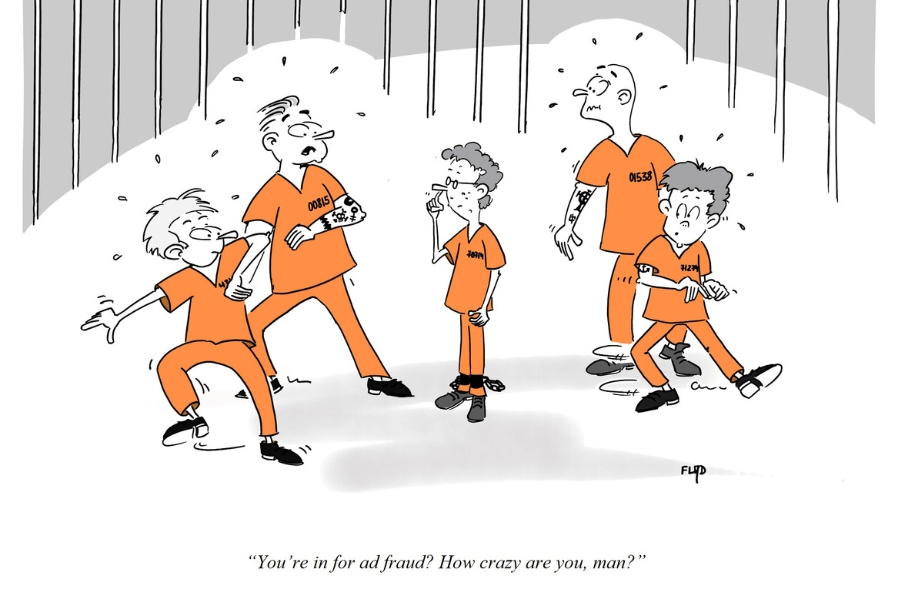
With the cost-of-living crisis biting, paying off the mortgage and covering rising energy bills is becoming a challenge. It’s made me realise I may need a side hustle. Ideally, one with great returns, low risk and minimal harm to society or the planet. After all, I’d still like to sleep at night. But what could possibly fit the bill?
While conventional wisdom tells us that crime doesn’t pay, what if I told you there is a global crime wave that costs businesses over $100 billion annually—a figure that some estimates project will reach $172 billion by 2028. Now, imagine this crime is so pervasive that it is occasionally discussed in the same breath as the world’s most destructive criminal enterprises. Yet, the very victims of the crime mostly shrug and treat the loss as a simple cost of doing business.
Welcome to the world of digital ad fraud in 2025. And frankly, I’m not convinced our industry really cares.
The scale of invalid traffic (IVT), botnets and domain spoofing now rivals or exceeds losses from illicit drug trades and complex financial fraud. Yet unlike those universally condemned crimes, ad fraud attracts little coordinated law enforcement, regulatory attention or moral outrage. In many markets, it’s not even considered an offence.
Even better, when asked if the industry can stop ad fraud, the answer is always the same—it's complicated. The evidence suggests the industry could absolutely minimise it to a predictable, manageable expense. The real question is: Why haven't we? The answer lies in a toxic trio: systemic disincentives, commercial conflicts of interest and widespread apathy across the digital ecosystem.
First, the structural disincentives. Ad fraud is treated as a normalised loss.
If a major bank lost 15 to 20% of annual transactions to organised theft, heads would roll, regulators would step in and police forces would mobilise worldwide. Yet the programmatic ecosystem budgets for similar losses as inevitable. It’s this mindset that fuels the problem—and makes ad fraud the perfect side hustle.
Then, there's the intentionally opaque supply chain. Digital advertising runs through layers of intermediaries such as DSPs, SSPs, exchanges and each takes a cut. Many benefit from volume-based revenue models that reward clicks and impressions, whether they’re human or bots.
Meaningfully reducing fraudulent traffic would reduce volume as well as revenue. Why would anyone voluntarily shrink their top line?
Cleaning up fraud would also force a painful reset of KPIs. If an agency's impression volume suddenly dropped by 20% because the invalid traffic was removed, marketers would panic, campaign performance reports would look catastrophic, and budgets would be questioned. The industry is addicted to inflated vanity metrics. Facing the truth requires collective bravery that few are willing to show.
But the failure is shared. The battle against ad fraud is winnable but only if every stakeholder steps up. Luckily, right now, responsibility is fractured.
The advertisers (the ultimate victim here) are the source of all funding and, therefore, the ultimate drivers of change. Yet, they are often the most passive victims. They must stop accepting fraud as a sunk cost. They could take a few significant actions immediately and unilaterally, but many don’t. They could demand contractual refunds with explicit language in all media contracts mandating a refund for any inventory later identified as IVT.
Or shift the focus of measurement away from easily-faked volume metrics like CPM/CPC and towards outcome-based measurement (e.g., incremental sales lift, marketing mix modelling). Bots can generate clicks, but they can’t buy products? This single action would automatically choke fraudulent channels. And they could enforce transparency by insisting that agencies and platforms comply with IAB Tech Lab standards, such as ads.txt and sellers.json, to verify the authorised sellers of inventory, thereby reducing domain spoofing immediately.
Next are the media agencies that are paid to be the trusted stewards of their clients' money, but many are failing this fiduciary duty. They would have to adopt a zero-tolerance cultural stance against ad fraud. This would mean working almost exclusively with partners that have achieved the TAG Certified Against Fraud (CAF) seal, signalling compliance with strict industry anti-fraud standards.
Implementing daily or weekly reconciliations between their spend logs and third-party verification tools can help pause budgets flowing to suspicious sources instantly. The failure to regularly audit is negligence. But great for the fraudsters.
Finally, media owners and platforms would have to stop seeking cheap, low-quality traffic to juice their impression numbers, and platforms must stop profiting from the complexity they created.
Publishers would need to clean their own traffic and maintain their ads.txt files diligently. Ad tech platforms, meanwhile, would have to make their systems fraud-resistant by default and embrace true transparency, even if it means sacrificing short-term revenue from high-volume, low-quality sources.
Many of the industry bodies, such as the ANA and the IAB, have done crucial work in creating the tools (TAG certification, MRC guidelines) needed to fight this fight. The missing piece is the will to enforce them.
A concerted effort is needed, equivalent to a joint task force on human trafficking or illicit finance, involving a centralised, mandatory mechanism for all certified industry participants to share data on new bot schemes and criminal IP addresses in real-time.
While the war on illicit drugs shows the difficulties global law enforcement agencies (like the FBI or Interpol) have in dismantling the organised criminal groups, the current trajectory sees ad fraud as a growing, permanent fixture of the digital economy. This narrative only benefits the criminals.
The choice before marketers, agencies and publishers is simple: keep bleeding billions quietly, or acknowledge ad fraud for what it is and meet it with equal force, integrity and urgency.
Until then, as side hustles go, ad fraud sadly remains one of the most lucrative. Tempted?
Woolley Marketing is a monthly column for Campaign Asia-Pacific, penned by Darren Woolley, the founder and global CEO of Trinity P3. The illustration accompanying this piece is by Dennis Flad, a Zurich-based marketing and advertising veteran.