

Mental health has become a bigger topic over the past decade, and the industry around it is growing fast. In Asia-Pacific alone, the mental health apps market is worth nearly US$2 billion in 2024 and is expected to more than double in the next five years, according to a report by Grand View Horizon.
On top of that, AI-powered solutions from chatbots to mood trackers are stepping into the spotlight, with global spending forecast to climb from US$1.8 billion in 2025 to almost US$8 billion in five years.
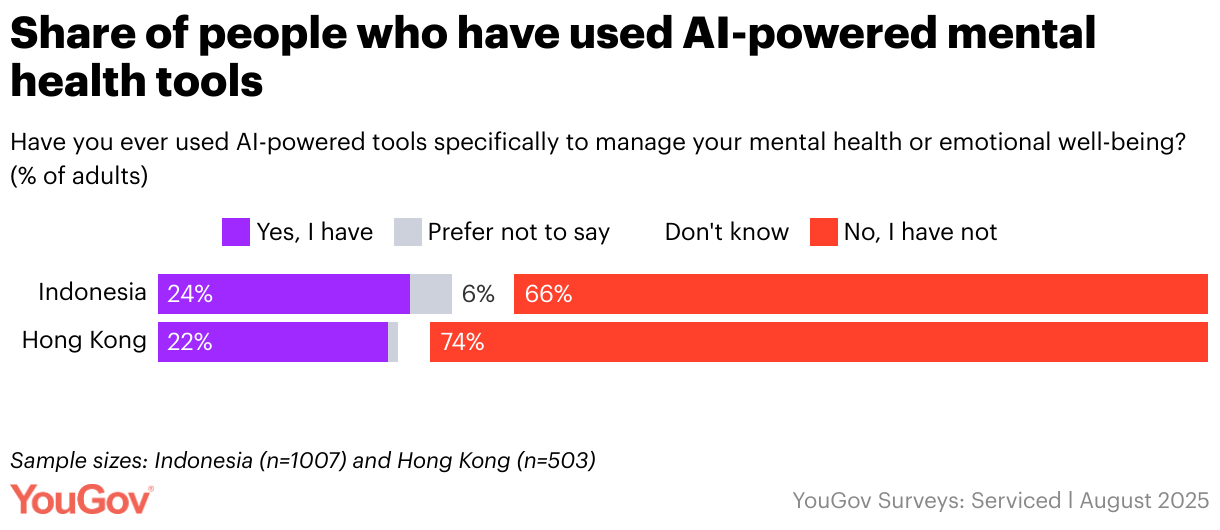
Yet adoption remains cautious. Exclusive YouGov research for Campaign Asia-Pacific, surveying representative samples in Indonesia and Hong Kong, shows only about a quarter of people have tried AI mental health tools: 24% in Indonesia and 22% in Hong Kong. The majority remain uninitiated, with 66% of Indonesians and 74% of Hong Kongers saying they’ve never used these solutions.
From mood tracking to crisis support
For early adopters, AI is being used in multiple ways. Mood tracking and behavioural analysis are the most common (46% in Indonesia, 45% in Hong Kong), followed by self-assessments or symptom checks (41% in Indonesia, 54% in Hong Kong). Emotional support via chatbots is also significant (40% in Indonesia, 46% in Hong Kong).
Structured tools are gaining traction, too. Personalised therapy prompts like mindfulness exercises or CBT are used by 25% in Indonesia and 39% in Hong Kong, while crisis support features reach 21% and 38%, respectively. Scheduling and reminder functions are less common but still notable (27% in Indonesia, 36% in Hong Kong).
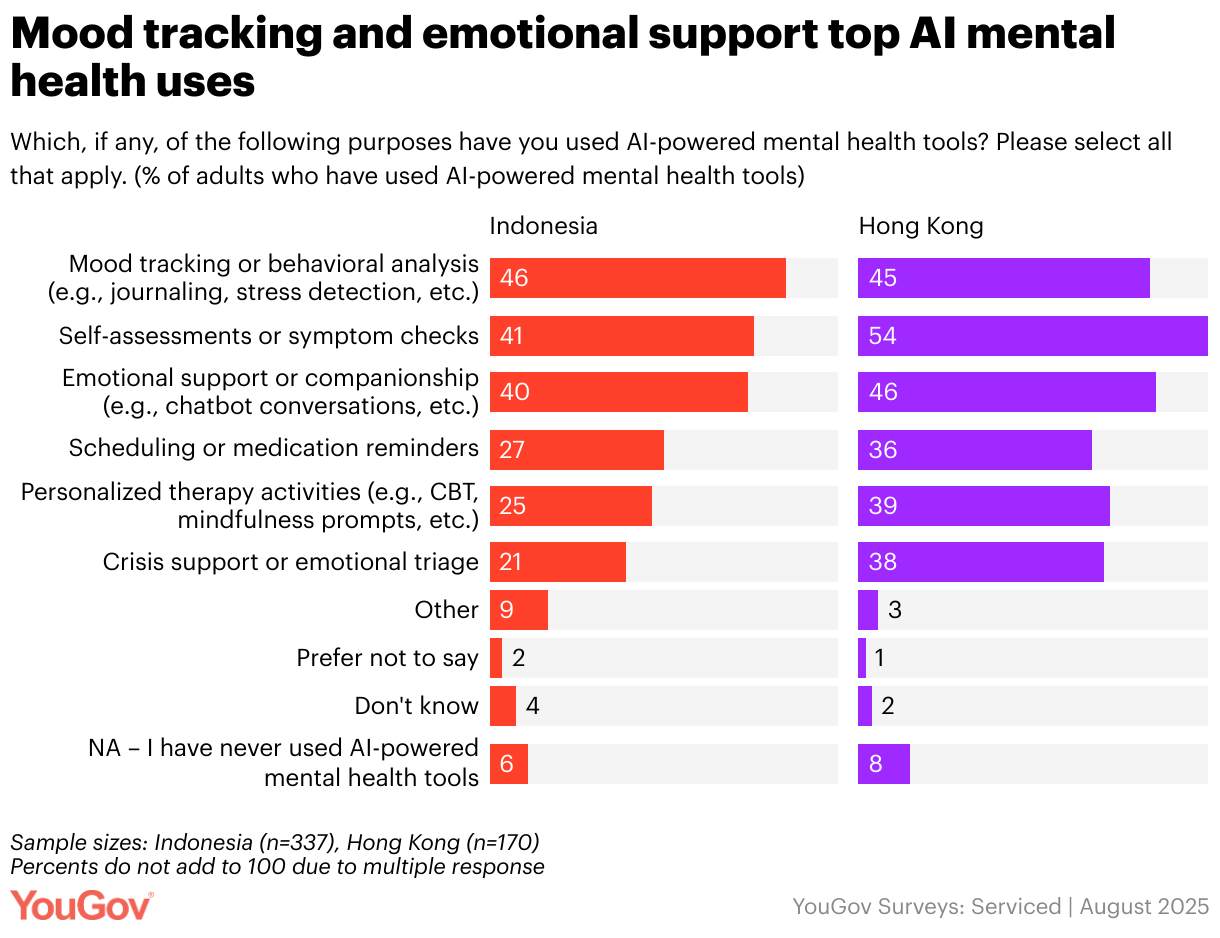
Scheduling and reminder functions, though less common, are part of the mix too – used by 27% in Indonesia and 36% in Hong Kong.
Taken together, what stands out is that experimentation is broad and multifaceted. People are using AI not just for quick reassurance or emotional tracking but also for structured self-improvement and crisis-related needs. The appetite to explore is clearly growing, though the intensity of use varies.
Why is there a hesitance to adoption?
For those who haven’t tried AI mental health tools, concerns cluster around three main themes: safety, empathy, and personalisation.
Safety: Privacy and data security top the list (45% in Indonesia, 42% in Hong Kong). Accuracy worries are also rife, with 24% of Indonesians and 39% of Hong Kongers fear harmful or incorrect advice.
Human touch: A lack of empathy weighs heavily. In Hong Kong, 39% question AI’s emotional intelligence and 45% doubt its grasp of human nuance. Indonesia shows similar patterns (31% and 30%).
Personalisation: Many feel AI tools are too generic. 18% in Indonesia and 36% in Hong Kong describe them as impersonal or not tailored enough to their needs.
Methodology: This study was conducted online in August 2025 with 1,007 Indonesian residents and 503 Hong Kong residents.
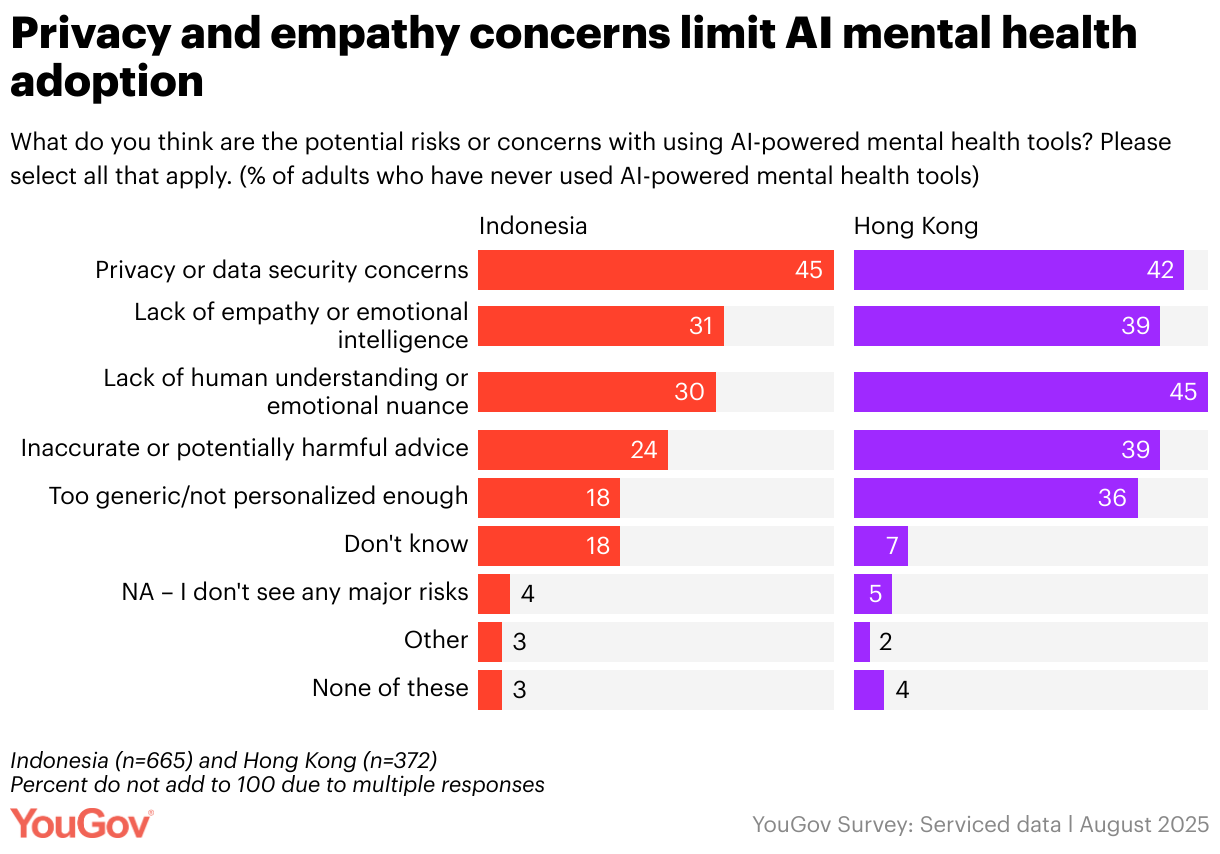
Users are willing to experiment, but in a space as intimate and emotionally charged as mental health, companies need to prove that AI can be safe, empathetic, and genuinely personalised or risk losing trust.
Methodology: This study was conducted online in August 2025 with 1,007 Indonesian residents and 503 Hong Kong residents.
Laura Robbie is the APAC CEO of YouGuv.




.jpg)


.jpg)
.png)